


Over the past few days, an infographic has taken over social media newsfeeds that includes a list of CDC guidelines for reopening schools in the U.S.
While the professionally-designed graphic appears to be an official communication, it actually is not. Information from the CDC more than likely will not start out as “Here we go New CDC guidelines for reopening schools”.
Although the information is somewhat accurate, it is displayed out of context. The guidelines seem unfeasible and restrictive, but with a quick trip to the CDC’s official website you will learn that the list is for schools to consider if “feasible, practical, and acceptable”.
The beginning paragraph on the CDC website begins with, “As some communities in the United States open K-12 schools, CDC offers the following considerations for ways in which schools can help protect students, teachers, administrators, and staff and slow the spread of COVID-19. Schools can determine, in collaboration with state and local health officials to the extent possible, whether and how to implement these considerations while adjusting to meet the unique needs and circumstances of the local community. Implementation should be guided by what is feasible, practical, acceptable, and tailored to the needs of each community. “
The document goes on to say, “These considerations are meant to supplement—not replace—any state, local, territorial, or tribal health and safety laws, rules, and regulations with which schools must comply.”
We encourage everyone to confirm sources of information and investigate for yourself before jumping to conclusions and sharing content on social media that may cause some to worry. Remember, we’re all in this together!
Download the CDC’s Considerations for Schools document here or view the complete text from CDC.gov below.
From the Center for Disease Control:
Considerations for Schools
Updated May 19, 2020
As some communities in the United States open K-12 schools, CDC offers the following considerations for ways in which schools can help protect students, teachers, administrators, and staff and slow the spread of COVID-19. Schools can determine, in collaboration with state and local health officials to the extent possible, whether and how to implement these considerations while adjusting to meet the unique needs and circumstances of the local community. Implementation should be guided by what is feasible, practical, acceptable, and tailored to the needs of each community. School-based health facilities may refer to CDC’s Guidance for U.S. Healthcare Facilities and may find it helpful to reference the Ten Ways Healthcare Systems Can Operate Effectively During the COVID-19 Pandemic. These considerations are meant to supplement—not replace—any state, local, territorial, or tribal health and safety laws, rules, and regulations with which schools must comply.
Guiding Principles to Keep in Mind
The more people a student or staff member interacts with, and the longer that interaction, the higher the risk of COVID-19 spread. The risk of COVID-19 spread increases in school settings as follows:
- Lowest Risk: Students and teachers engage in virtual-only classes, activities, and events.
- More Risk: Small, in-person classes, activities, and events. Groups of students stay together and with the same teacher throughout/across school days and groups do not mix. Students remain at least 6 feet apart and do not share objects (e.g., hybrid virtual and in-person class structures, or staggered/rotated scheduling to accommodate smaller class sizes).
- Highest Risk: Full sized, in-person classes, activities, and events. Students are not spaced apart, share classroom materials or supplies, and mix between classes and activities.
COVID-19 is mostly spread by respiratory droplets released when people talk, cough, or sneeze. It is thought that the virus may spread to hands from a contaminated surface and then to the nose or mouth, causing infection. Therefore, personal prevention practices (such as handwashing, staying home when sick) and environmental cleaning and disinfection are important principles that are covered in this document. Fortunately, there are a number of actions school administrators can take to help lower the risk of COVID-19 exposure and spread during school sessions and activities.
Promoting Behaviors that Reduce Spread
Schools may consider implementing several strategies to encourage behaviors that reduce the spread of COVID-19.
- Staying Home when Appropriate
- Educate staff and families about when they/their child(ren) should stay home and when they can return to school.
- Actively encourage employees and students who are sick or who have recently had close contact with a person with COVID-19 to stay home. Develop policies that encourage sick employees and students to stay at home without fear of reprisal, and ensure employees, students, and students’ families are aware of these policies. Consider not having perfect attendance awards, not assessing schools based on absenteeism, and offering virtual learning and telework options, if feasible.
- Staff and students should stay home if they have tested positive for or are showing COVID-19 symptoms.
- Staff and students who have recently had close contact with a person with COVID-19 should also stay home and monitor their health.
- CDC’s criteria can help inform when employees should return to work:
- Hand Hygiene and Respiratory Etiquette
- Teach and reinforce handwashing with soap and water for at least 20 seconds and increase monitoring to ensure adherence among students and staff.
- If soap and water are not readily available, hand sanitizer that contains at least 60% alcohol can be used (for staff and older children who can safely use hand sanitizer).
- Encourage staff and students to cover coughs and sneezes with a tissue. Used tissues should be thrown in the trash and hands washed immediately with soap and water for at least 20 seconds.
- If soap and water are not readily available, hand sanitizer that contains at least 60% alcohol can be used (for staff and older children who can safely use hand sanitizer).
- Teach and reinforce handwashing with soap and water for at least 20 seconds and increase monitoring to ensure adherence among students and staff.
- Cloth Face Coverings
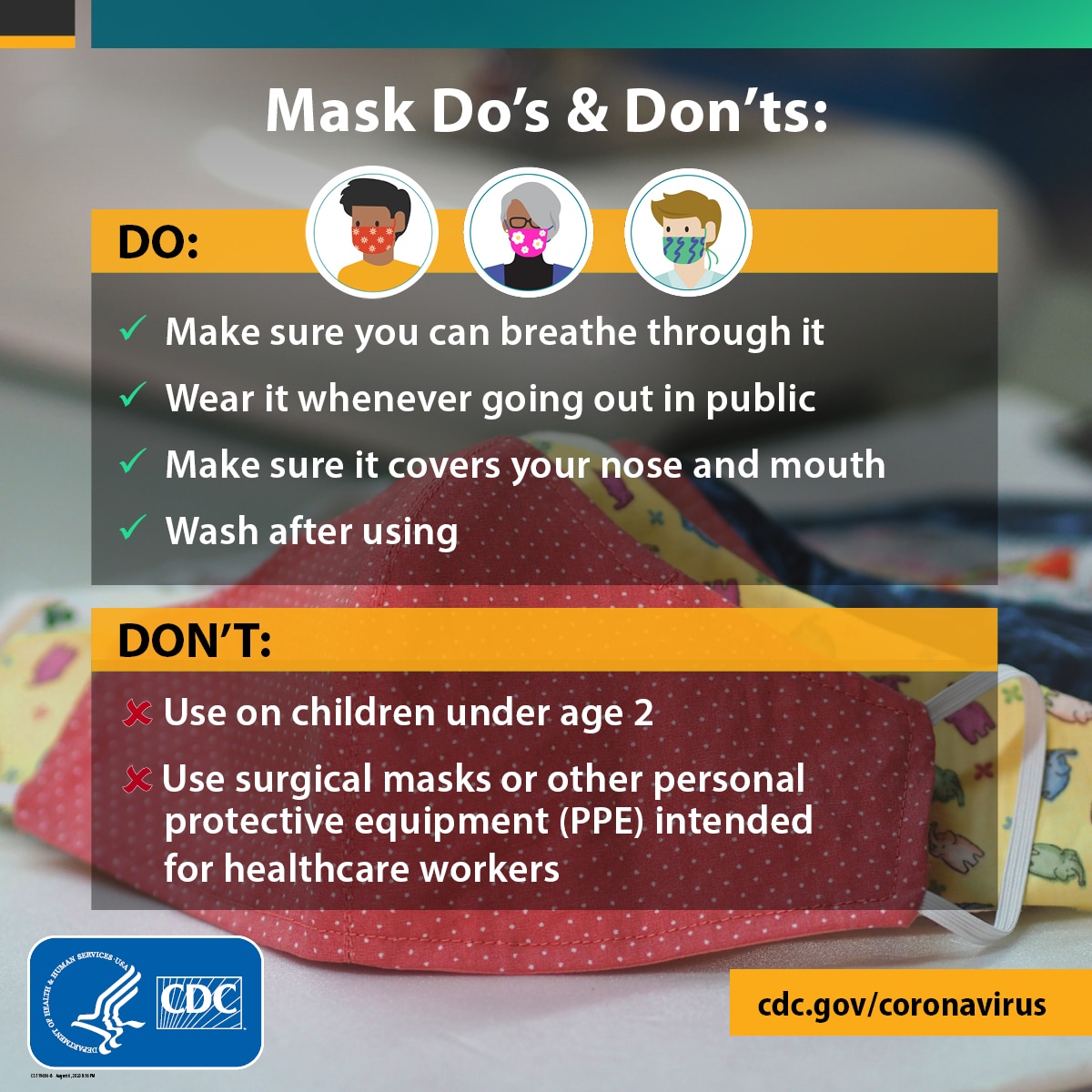
- Teach and reinforce use of cloth face coverings. Face coverings may be challenging for students (especially younger students) to wear in all-day settings such as school. Face coverings should be worn by staff and students (particularly older students) as feasible, and are most essential in times when physical distancing is difficult. Individuals should be frequently reminded not to touch the face covering and to wash their hands frequently. Information should be provided to staff, students, and students’ families on proper use, removal, and washing of cloth face coverings.
- Note: Cloth face coverings should not be placed on:
- Children younger than 2 years old
- Anyone who has trouble breathing or is unconscious
- Anyone who is incapacitated or otherwise unable to remove the cloth face covering without assistance
- Note: Cloth face coverings should not be placed on:
- Cloth face coverings are meant to protect other people in case the wearer is unknowingly infected but does not have symptoms. Cloth face coverings are not surgical masks, respirators, or other medical personal protective equipment.
- Teach and reinforce use of cloth face coverings. Face coverings may be challenging for students (especially younger students) to wear in all-day settings such as school. Face coverings should be worn by staff and students (particularly older students) as feasible, and are most essential in times when physical distancing is difficult. Individuals should be frequently reminded not to touch the face covering and to wash their hands frequently. Information should be provided to staff, students, and students’ families on proper use, removal, and washing of cloth face coverings.
- Adequate Supplies
- Support healthy hygiene behaviors by providing adequate supplies, including soap, hand sanitizer with at least 60 percent alcohol (for staff and older children who can safely use hand sanitizer), paper towels, tissues, disinfectant wipes, cloth face coverings (as feasible) and no-touch/foot-pedal trash cans.
- Signs and Messages
- Post signs in highly visible locations (e.g., school entrances, restrooms) that promote everyday protective measurespdf icon and describe how to stop the spreadpdf icon of germs (such as by properly washing hands and properly wearing a cloth face coveringimage icon).
- Broadcast regular announcements on reducing the spread of COVID-19 on PA systems.
- Include messages (for example, videos) about behaviors that prevent the spread of COVID-19 when communicating with staff and families (such as on school websites, in emails, and on school social media accounts).
- Find free CDC print and digital resources on CDC’s communications resources main page.
Maintaining Healthy Environments
Schools may consider implementing several strategies to maintain healthy environments.
- Cleaning and Disinfection
- Clean and disinfect frequently touched surfaces (e.g., playground equipment, door handles, sink handles, drinking fountains) within the school and on school buses at least daily or between use as much as possible. Use of shared objects (e.g., gym or physical education equipment, art supplies, toys, games) should be limited when possible, or cleaned between use.
- If transport vehicles (e.g., buses) are used by the school, drivers should practice all safety actions and protocols as indicated for other staff (e.g., hand hygiene, cloth face coverings). To clean and disinfect school buses or other transport vehicles, see guidance for bus transit operators.
- Develop a schedule for increased, routine cleaning and disinfection.
- Ensure safe and correct use and storage of cleaning and disinfection productsexternal icon, including storing products securely away from children. Use products that meet EPA disinfection criteriaexternal icon.
- Cleaning products should not be used near children, and staff should ensure that there is adequate ventilation when using these products to prevent children or themselves from inhaling toxic fumes.
- Shared Objects
- Discourage sharing of items that are difficult to clean or disinfect.
- Keep each child’s belongings separated from others’ and in individually labeled containers, cubbies, or areas.
- Ensure adequate supplies to minimize sharing of high touch materials to the extent possible (e.g., assigning each student their own art supplies, equipment) or limit use of supplies and equipment by one group of children at a time and clean and disinfect between use.
- Avoid sharing electronic devices, toys, books, and other games or learning aids.
- Ventilation
- Ensure ventilation systems operate properly and increase circulation of outdoor air as much as possible, for example by opening windows and doors. Do not open windows and doors if doing so poses a safety or health risk (e.g., risk of falling, triggering asthma symptoms) to children using the facility.
- Water Systems
- To minimize the risk of Legionnaire’s disease and other diseases associated with water, take steps to ensure that all water systems and features (e.g., sink faucets, drinking fountains, decorative fountains) are safe to use after a prolonged facility shutdown. Drinking fountains should be cleaned and sanitized, but encourage staff and students to bring their own water to minimize use and touching of water fountains.
- Modified Layouts
- Space seating/desks at least 6 feet apart when feasible.
- Turn desks to face in the same direction (rather than facing each other), or have students sit on only one side of tables, spaced apart.
- Create distance between children on school buses (g., seat children one child per row, skip rows) when possible.
- Physical Barriers and Guides
- Install physical barriers, such as sneeze guards and partitions, particularly in areas where it is difficult for individuals to remain at least 6 feet apart (e.g., reception desks).
- Provide physical guides, such as tape on floors or sidewalks and signs on walls, to ensure that staff and children remain at least 6 feet apart in lines and at other times (e.g. guides for creating “one way routes” in hallways).
- Communal Spaces
- Close communal use shared spaces such as dining halls and playgrounds with shared playground equipment if possible; otherwise, stagger use and clean and disinfect between use.
- Add physical barriers, such as plastic flexible screens, between bathroom sinks especially when they cannot be at least 6 feet apart.
- Food Service
- Have children bring their own meals as feasible, or serve individually plated meals in classrooms instead of in a communal dining hall or cafeteria, while ensuring the safety of children with food allergies.pdf icon
- Use disposable food service items (e.g., utensils, dishes). If disposable items are not feasible or desirable, ensure that all non-disposable food service items are handled with gloves and washed with dish soap and hot water or in a dishwasher. Individuals should wash their hands after removing their gloves or after directly handling used food service items.
- If food is offered at any event, have pre-packaged boxes or bags for each attendee instead of a buffet or family-style meal. Avoid sharing food and utensils and ensure the safety of children with food allergies.pdf icon
Maintaining Healthy Operations
Schools may consider implementing several strategies to maintain healthy operations.
- Protections for Staff and Children at Higher Risk for Severe Illness from COVID-19
- Offer options for staff at higher risk for severe illness (including older adults and people of all ages with certain underlying medical conditions) that limit their exposure risk (e.g., telework, modified job responsibilities that limit exposure risk).
- Offer options for students at higher risk of severe illness that limit their exposure risk (e.g., virtual learning opportunities).
- Consistent with applicable law, put in place policies to protect the privacy of people at higher risk for severe illness regarding underlying medical conditions.
- Regulatory Awareness
- Be aware of local or state regulatory agency policies related to group gatherings to determine if events can be held.
- Gatherings, Visitors, and Field Trips
- Pursue virtual group events, gatherings, or meetings, if possible, and promote social distancing of at least 6 feet between people if events are held. Limit group size to the extent possible.
- Limit any nonessential visitors, volunteers, and activities involving external groups or organizations as possible – especially with individuals who are not from the local geographic area (e.g., community, town, city, county).
- Pursue virtual activities and events in lieu of field trips, student assemblies, special performances, school-wide parent meetings, and spirit nights, as possible.
- Pursue options to convene sporting events and participation in sports activities in ways that minimizes the risk of transmission of COVID-19 to players, families, coaches, and communities.
- Identifying Small Groups and Keeping Them Together (Cohorting)
- Ensure that student and staff groupings are as static as possible by having the same group of children stay with the same staff (all day for young children, and as much as possible for older children).
- Limit mixing between groups if possible.
- Staggered Scheduling
- Stagger arrival and drop-off times or locations by cohort or put in place other protocols to limit contact between cohorts and direct contact with parents as much as possible.
- When possible, use flexible worksites (e.g., telework) and flexible work hours (e.g., staggered shifts) to help establish policies and practices for social distancing (maintaining distance of approximately 6 feet) between employees and others, especially if social distancing is recommended by state and local health authorities.
- Designated COVID-19 Point of Contact
- Designate a staff person to be responsible for responding to COVID-19 concerns (e.g., school nurse). All school staff and families should know who this person is and how to contact them.
- Participation in Community Response Efforts
- Consider participating with local authorities in broader COVID-19 community response efforts (e.g., sitting on community response committees).
- Communication Systems
- Put systems in place for:
- Consistent with applicable law and privacy policies, having staff and families self-report to the school if they or their student have symptoms of COVID-19, a positive test for COVID-19, or were exposed to someone with COVID-19 within the last 14 days in accordance with health information sharing regulations for COVID-19external icon (e.g. see “Notify Health Officials and Close Contacts” in the Preparing for When Someone Gets Sick section below) and other applicable federal and state laws and regulations relating to privacy and confidentiality, such as the Family Educational Rights and Privacy Act (FERPA).
- Notifying staff, families, and the public of school closures and any restrictions in place to limit COVID-19 exposure (e.g., limited hours of operation).
- Put systems in place for:
- Leave (Time Off) Policies and Excused Absence Policies
- Implement flexible sick leave policies and practices that enable staff to stay home when they are sick, have been exposed, or caring for someone who is sick.
- Examine and revise policies for leave, telework, and employee compensation.
- Leave policies should be flexible and not punish people for taking time off, and should allow sick employees to stay home and away from co-workers. Leave policies should also account for employees who need to stay home with their children if there are school or childcare closures, or to care for sick family members.
- Develop policies for return-to-school after COVID-19 illness. CDC’s criteria to discontinue home isolation and quarantine can inform these policies.
- Implement flexible sick leave policies and practices that enable staff to stay home when they are sick, have been exposed, or caring for someone who is sick.
- Back-Up Staffing Plan
- Monitor absenteeism of students and employees, cross-train staff, and create a roster of trained back-up staff.
- Staff Training
- Train staff on all safety protocols.
- Conduct training virtually or ensure that social distancing is maintained during training.
- Recognize Signs and Symptoms
- If feasible, conduct daily health checks (e.g., temperature screening and/or or symptom checking) of staff and students.
- Health checks should be conducted safely and respectfully, and in accordance with any applicable privacy laws and regulations. School administrators may use examples of screening methods in CDC’s supplemental Guidance for Child Care Programs that Remain Open as a guide for screening children and CDC’s General Business FAQs for screening staff.
- Sharing Facilities
- Encourage any organizations that share or use the school facilities to also follow these considerations.
- Support Coping and Resilience
- Encourage employees and students to take breaks from watching, reading, or listening to news stories about COVID-19, including social media if they are feeling overwhelmed or distressed.
- Promote employees and students eating healthy, exercising, getting sleep, and finding time to unwind.
- Encourage employees and students to talk with people they trust about their concerns and how they are feeling.
- Consider posting signages for the national distress hotline: 1-800-985-5990, or text TalkWithUsto 66746
Preparing for When Someone Gets Sick
Schools may consider implementing several strategies to prepare for when someone gets sick.
- Advise Staff and Families of Sick Students of Home Isolation Criteria
- Sick staff members or students should not return until they have met CDC’s criteria to discontinue home isolation.
- Isolate and Transport Those Who are Sick
- Make sure that staff and families know that they (staff) or their children (families) should not come to school, and that they should notify school officials (e.g., the designated COVID-19 point of contact) if they (staff) or their child (families) become sick with COVID-19 symptoms, test positive for COVID-19, or have been exposed to someone with COVID-19 symptoms or a confirmed or suspected case.
- Immediately separate staff and children with COVID-19 symptoms (such as fever, cough, or shortness of breath) at school. Individuals who are sick should go home or to a healthcare facility depending on how severe their symptoms are, and follow CDC guidance for caring for oneself and others who are sick.
- Work with school administrators, nurses, and other healthcare providers to identify an isolation room or area to separate anyone who has COVID-19 symptoms or tests positive but does not have symptoms. School nurses and other healthcare providers should use Standard and Transmission-Based Precautions when caring for sick people. See: What Healthcare Personnel Should Know About Caring for Patients with Confirmed or Possible COVID-19 Infection.
- Establish procedures for safely transporting anyone who is sick to their home or to a healthcare facility. If you are calling an ambulance or bringing someone to the hospital, try to call first to alert them that the person may have COVID-19.
- Clean and Disinfect
- Close off areas used by a sick person and do not use these areas until after cleaning and disinfecting
- Wait at least 24 hours before cleaning and disinfecting. If 24 hours is not feasible, wait as long as possible. Ensure safe and correct use and storage of cleaning and disinfection productsexternal icon, including storing products securely away from children.
- Notify Health Officials and Close Contacts
- In accordance with state and local laws and regulations, school administrators should notify local health officials, staff, and families immediately of any case of COVID-19 while maintaining confidentiality in accordance with the Americans with Disabilities Act (ADA)external icon.
- Inform those who have had close contact with a person diagnosed with COVID-19 to stay home and self-monitor for symptoms, and follow CDC guidance if symptoms develop.
Featured photo by Pexels.